Private Milan highlights walking tour
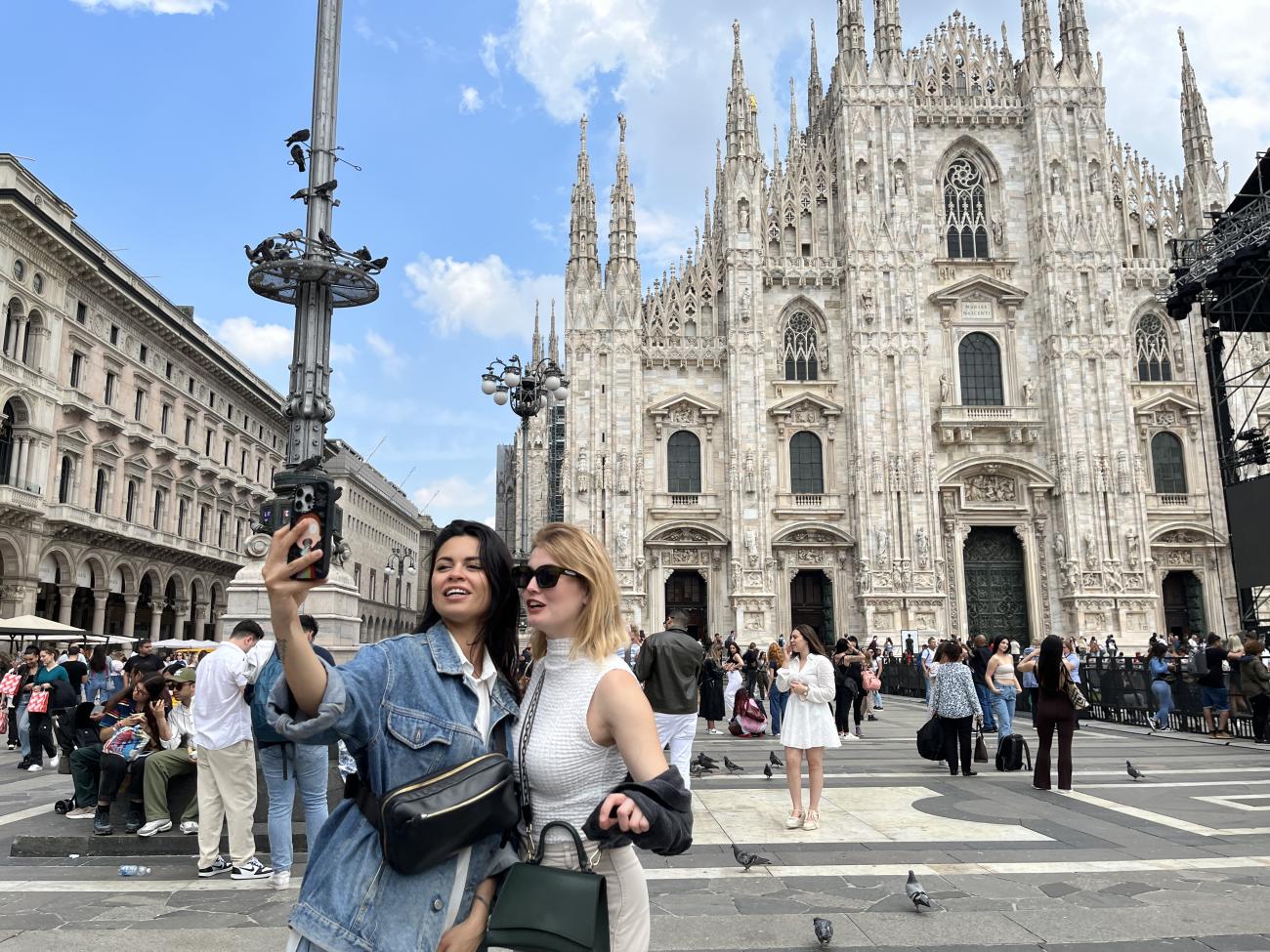


Experience Milan like never before with a private walking tour that blends history, architecture, and modern elegance.
- Enjoy a fully customized private walking tour tailored to your interests
- Discover Milan’s historic landmarks like the Royal Palace and Galleria Vittorio Emanuele
- Marvel at the breathtaking Duomo Cathedral, a masterpiece of Gothic architecture
- Explore La Scala Theatre, one of the world’s most prestigious opera houses
- Stroll through Milan’s vibrant streets, where fashion, art, and culture come to life
Meeting Point
Meet our guide in Piazza Duomo n.25, in front of "Rocca 1794" shop, under the loggias.
What are the most important landmarks in Milan that a private walking tour covers?
A private walking tour of Milan typically covers the city's historic centre, where the density of significant landmarks is extraordinary within a relatively compact area. The Piazza del Duomo — the cathedral square — is the natural starting point: the Duomo itself, the Galleria Vittorio Emanuele II, and the Royal Palace are all immediately adjacent. From there, a walking tour can move north toward the Brera neighbourhood — home to the Pinacoteca di Brera, one of Italy's great art museums — or west toward the Castello Sforzesco, the massive 15th-century fortress of the Sforza dukes that anchors the western end of the historic centre. The Navigli canal district, the Porta Nuova business district, and the fashion quadrilateral (Via Montenapoleone, Via della Spiga) all offer different perspectives on the city. The private format allows the guide to adapt the route entirely to the interests and pace of your group.
What is the Galleria Vittorio Emanuele II and why is it significant beyond being a shopping arcade?
The Galleria Vittorio Emanuele II is one of the most architecturally significant commercial buildings in Europe and one of the oldest surviving shopping malls in the world. Built between 1865 and 1877 to the design of architect Giuseppe Mengoni, it connects the Piazza del Duomo to the Piazza della Scala via a cruciform arcade covered by an iron and glass barrel vault and a central octagonal dome — a feat of 19th-century engineering that was revolutionary at the time of its construction. The Galleria is named for Vittorio Emanuele II, the first king of unified Italy, and its construction was a deliberate statement about Milan's place in the new Italian nation. Today it houses some of Milan's most historic cafes — the Camparino, where the Campari cocktail was invented — and the flagship stores of international luxury brands. But the building itself, with its mosaics, its painted vaults, and the view up through the dome, is more significant than anything sold within it.
What is La Scala and why is it considered the most famous opera house in the world?
Teatro alla Scala — universally known simply as 'La Scala' — is Milan's opera house, built in 1778 on the site of the church of Santa Maria alla Scala (from which it takes its name). It is widely regarded as the most prestigious opera house in the world — not because it is the largest or the oldest, but because of the extraordinary concentration of world premieres, legendary performances, and transformative artistic figures associated with it over nearly 250 years. The world premieres of Verdi's Otello and Falstaff, Puccini's La Gioconda, and Bellini's Norma all took place at La Scala. Toscanini conducted there for twenty years. Callas made her triumphant debut there in 1942. The house seats approximately 2,030 in the auditorium and is renowned for the acoustics of its horseshoe-shaped hall. A private walking tour of Milan includes La Scala's exterior and the adjacent Piazza della Scala — and can be combined with a visit to the museum inside the theatre.
What is the history of Milan from ancient Roman city to modern fashion and design capital?
Milan's history spans over 2,600 years and encompasses a series of transformations that few European cities can match. Founded as Mediolanum by the Celtic Insubres around 600 BCE, it was conquered by the Romans in 222 BCE and grew to become one of the most important cities in the Western Roman Empire — briefly the imperial capital under Diocletian and Maximian in the late 3rd century CE. The Edict of Milan (313 CE), which granted religious tolerance throughout the empire, was issued here. In the medieval period Milan became a city-state under the Visconti family, then the Sforza (whose Castello Sforzesco still dominates the city centre), before passing to Spanish, then Austrian control. The 19th century brought industrialisation, the Risorgimento, and the transformation of Milan into the economic capital of unified Italy. The 20th century established Milan as the global capital of fashion and design — a reputation consolidated by the biannual Fashion Week and the Salone del Mobile furniture fair.
Why choose a private walking tour of Milan over a group tour or self-guided visit?
A private walking tour of Milan offers three advantages that neither a group tour nor a self-guided visit can match: pace, depth, and personalisation. On a group tour, the guide is managing the interests and questions of a large number of people simultaneously — the experience is necessarily generic, the pace fixed, and the content pitched at an average level. On a self-guided visit with a map or audio guide, you are dependent on what the guidebook includes, and you have no one to answer the specific question you have just thought of. A private tour with a knowledgeable local guide gives you the full attention of an expert: the pace adapts to your speed and interest level, the content responds to your questions, and the route can be adjusted in real time if something catches your attention or if you want to spend more time somewhere. For first-time visitors to Milan who want to understand what they are seeing, or for returning visitors who want to go deeper into a specific aspect of the city, the private format is the most efficient and most satisfying way to explore.
What is the cancellation policy?
For groups of 1 to 8 people, a full cancellation fee applies if you cancel within 7 days of your tour date or in case of no-show. For groups of 9 or more, availability and cancellation terms are available on request.


Starting from
price per person
based on a group of 4